
Air fryer size guide: what capacity you really need, plus single basket vs dual zone and running costs
 27/01/2026
Air fryers are one of those purchases that can feel obvious until you try to choose one. Listings are packed with litres, watts, drawers and “programmes”, yet the real question is simpler: will it cook the food you actually eat, in the quantity you actually need, without becoming another bulky gadget you avoid using?
Quick answer (if you want the decision in 30 seconds):
- 3L to 4L: usually comfortable for one to two people, or smaller portions.
- 5L to 6L: a common sweet spot for two to four people and everyday mains.
- Dual zone: best when you want two foods finished together, with different timings.
- Oven-style: best when you want racks and surface area, and you have the space.
This guide is designed to help you buy once and be happy with it. In plain terms, an air fryer is a compact convection oven. It moves hot air quickly around your food, which is why it can crisp well when you give the airflow room to do its job. If you want to explore the wider category while you read, Appliances is a useful starting point.
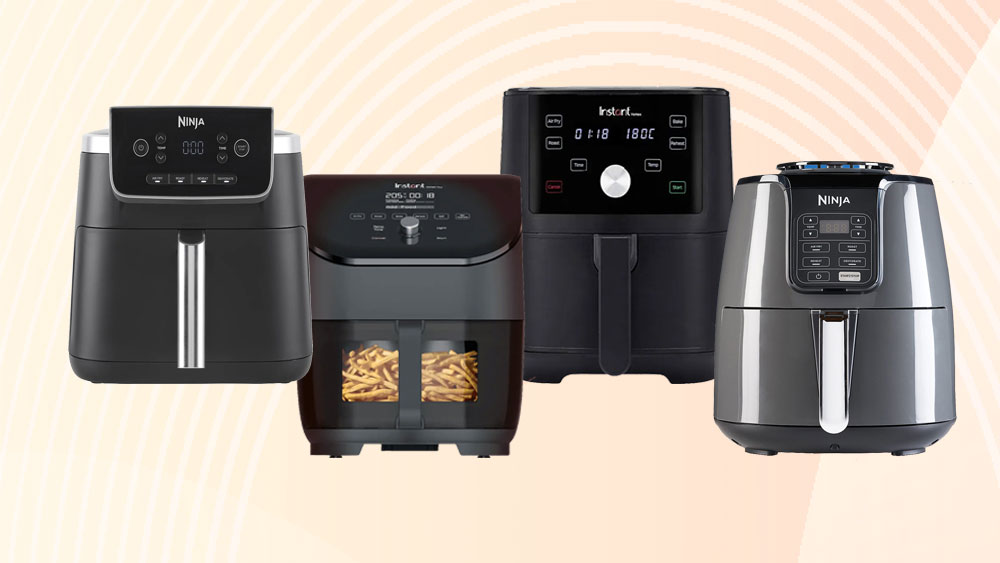
Air fryer capacity explained: the litre number is not the full story
When people search “how many litres air fryer do I need” or “best air fryer size for a family of four”, they are usually trying to avoid one of two annoyances: cooking in endless batches, or sacrificing worktop space for capacity they never use.
The key detail is that litres measure internal volume, not usable cooking area. Two “6 litre air fryers” can cook very differently if one has a wide, shallow basket and the other is tall and narrow. For crisp results, the best habit is single-layer cooking, with a little breathing room between pieces. If food is piled high, you can still cook it, but you will shake, turn, and extend the time more often to get even browning.
Two common mistakes to avoid:
- Buying by “total litres” alone (it does not tell you how wide the basket is).
- Expecting crispness when food is tightly stacked (air needs space to circulate).
A practical way to choose is to think in portions you cook on a normal weekday:
- One to two people who cook smaller portions most days often feel comfortable around a 3L to 4L basket.
- Two to four people who want one-batch sides and easy mains often land around 5L to 6L.
- Families who want “chips in one drawer, chicken in the other” tend to prefer a dual zone air fryer where each drawer can handle a sensible portion on its own.
Table 1 is a realistic starting point. Basket shape, rack design and what you cook will always matter more than a single headline number, so treat the “best for” column as guidance, not a promise.
Table 1: Air fryer size guide (capacity, typical use, and who it suits)
| Capacity band | Best for | Typical meals that fit well | What to watch for |
|---|---|---|---|
| 3L to 4L | One to two people, smaller kitchens | Chips for two, chicken thighs, salmon portions, roasted veg, pastries | Expect batches for wings, thicker chips, or mixed meals |
| 5L to 6L | Two to four people, everyday mains | Bigger chicken portions, halloumi and veg, frozen favourites, family sides | Wide baskets usually brown more evenly than tall narrow baskets |
| 7L to 8L (often dual zone total) | Families and mixed meals | Protein in one drawer, chips or veg in the other, different timings | “Total litres” can mislead. Two drawers behave differently to one big basket |
| 9L to 11L (oven-style or large format) | Batch cooking, tray-style meals, entertaining | Multiple racks, flatter tray bakes, larger quantities without stacking | Footprint and airflow matter. Check rack spacing and cleaning effort |
If you are browsing beyond air fryers, Small Kitchen Appliances is the natural place to explore this whole worktop category.
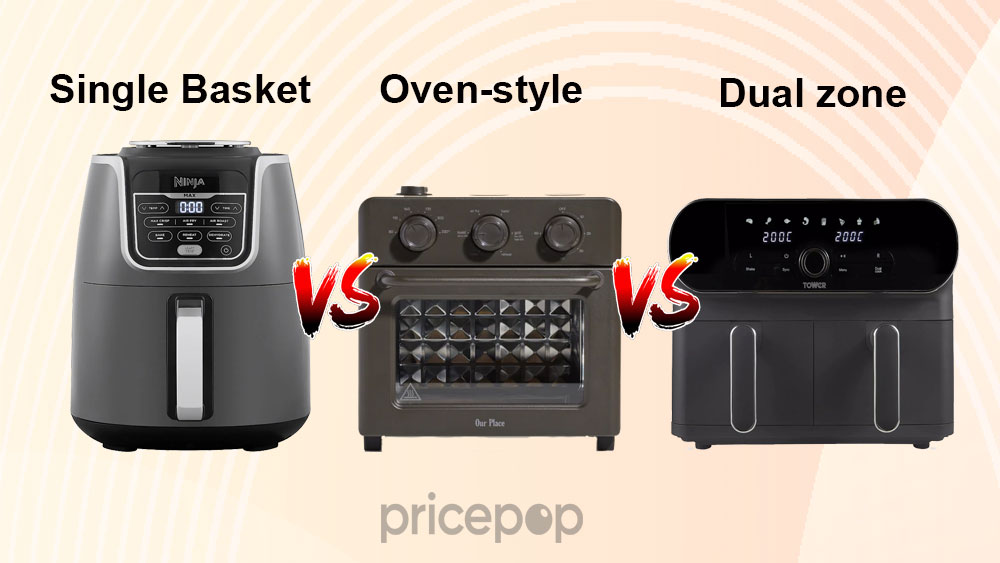
Single basket vs dual zone vs oven-style air fryer: choose the format that matches your meals
This decision usually affects satisfaction more than wattage or the number of presets.
Single basket air fryer
A single basket is the simplest format. It suits people who cook one main item at a time, or who mainly want crisping and reheating: chips, breaded foods, pastries, leftovers that you want to revive, and quick proteins. If your searches look like “best air fryer for one person” or “small air fryer for two people”, this is often the best match, provided the basket is wide enough for what you like to cook.
Dual zone air fryer (two drawers)
Dual drawers are built for real meals where foods want different times or temperatures. That could be chips plus chicken, veg plus protein, or a “messy” drawer and a “clean” drawer. If you keep finding yourself asking “is a dual zone air fryer worth it”, the honest answer is yes if you regularly cook for three to five people or you want dinner to finish together without batch cooking.
Two practical features to look for on dual zone models:
- A “sync finish” or “match cook” style feature that helps different foods finish at the same time.
- Independent temperature and time controls for each drawer (so you are not forced into one compromise setting).
The trade-off is that each drawer is smaller than a single large basket, so very large items may not fit as easily.
Oven-style air fryer (racks and trays)
Oven-style models are about surface area and flexibility. Multiple racks can be brilliant for batch cooking or when you want food spread out, but they can be bulkier and a bit more fiddly to clean. People comparing “air fryer oven 10 litre vs dual basket” are often choosing between capacity on one side and timed, independent cooking on the other.
Comparison: a quick format shortcut
- Choose single basket if you value simplicity and mostly cook one main item at a time.
- Choose dual zone if you want two foods cooked properly at once, especially for family meals.
- Choose oven-style if you want rack cooking and larger quantities, and you have the space to keep it accessible.
If you are ready to compare models by size and format, Air Fryers & Fryers is the most relevant starting point.
The specs that decide results: wattage, temperature control, and the features that matter in real life
Wattage can be useful context, but it is not a guarantee. Many air fryers sit somewhere around 800W to 2,000W, and higher wattage can help preheat faster and recover heat after you open the drawer. In practice, airflow design, basket layout and temperature stability are just as important for crisping and even browning.
If you are comparing “air fryer wattage 1700W vs 2000W”, treat wattage as a tiebreaker after you have checked the basics:
- Basket shape: wider baskets tend to brown more evenly.
- Airflow underneath: a good crisper plate or rack can improve crispness without extra oil.
- Build quality: drawers that slide smoothly and seal well tend to cook more consistently.
Temperature range is similar. For most households, consistent control across everyday temperatures matters more than chasing an extreme maximum. Lower minimum temperatures can be helpful if you bake, warm, or dehydrate, but the most common weekly wins are crisping, roasting and reheating.
Cleaning and usability: the feature that decides whether you keep using it
If you want an air fryer you will actually use mid-week, cleaning is not a footnote. Searches like “air fryer with dishwasher-safe basket” exist because awkward clean-up kills momentum. Look for:
- Dishwasher-safe basket and plates where possible.
- Coatings that release residue easily.
- Corners and vents that do not trap grease.
- A size that fits your sink and drying space as well as your worktop.
Running costs: when an air fryer is cheaper than an oven, and when it is not
A common question is “is an air fryer cheaper to run than an oven”. Often, yes for smaller portions, because an air fryer is a smaller space to heat and it can cook faster for the same meal. The flip side is that a full-size oven can make more sense when you are cooking a large tray or multiple dishes at once, because you are spreading the energy cost across more food. Your electricity tariff and how long you cook for will always be the deciding details.
Microwaves sit in a different lane. For reheating and quick cooking, they can be very efficient because they heat food directly rather than heating a whole chamber of air. If your routine is batch-cook once and reheat portions through the week, a microwave plus an air fryer can be a very practical pairing.
If you are thinking about quick meals and reheating as well as air frying, Microwaves is worth exploring.
If you cook larger roasts, trays and batch meals regularly, Ovens remains the workhorse category for that style of cooking.
A simple final checklist before you buy
- What do you cook most: crisp sides, proteins, reheating, baking, or a bit of everything?
- How many portions do you cook on a normal weekday, not on special occasions?
- Do you need two independent drawers, or do you mainly cook one item at a time?
- Will it sit out on the worktop, and does it fit your space without being annoying?
- Are the parts easy to clean, and will you still be happy cleaning it twice a week?
Notes on accuracy and how this guide was written
This article focuses on behaviours that reliably change the experience: usable cooking area versus volume, airflow and single-layer cooking, and the practical differences between a single basket, a dual zone drawer design, and an oven-style rack layout. For running-cost principles we cross-checked independent energy guidance that compares small-appliance cooking with ovens and microwaves. Where performance varies by model, the advice avoids brand promises and instead emphasises checks you can validate, such as basket dimensions, ease of cleaning, warranty length, and independent reviews that measure real cooking performance.